
Art in the City: Planning Heritage in Akadimia Platonos, Athens
Research and report by Chiara Liastro, Ella Koehorst, and Dina Onish (Vrije Universiteit Amsterdam), and Mia Bellouere and Éadaoin O'Flaherty (University of Gothenburg), 2026.
In 2023, the Municipality of Athens announced plans for a new archaeological museum inside Akadimia Platonos, the public park that holds the remains of Plato's Academy. The project would remove hundreds of trees and significantly shrink one of the few green spaces in this working-class neighbourhood, and local residents have pushed back, arguing the museum belongs elsewhere. This report and design proposal imagines an alternative future for the park — one that centers its archaeological heritage without displacing the everyday life already built around it, using art as the tool to hold both together.
RESEARCH QUESTION
What is the potential role of art in planning heritage? How can heritage inform art in Akadimia Platonos?
FRAMING THE RESEARCH
The proposal grew out of a literature review spanning urban planning, archaeology, sociology, and art. Malcolm Miles' writing on art and the city, and Dimitris Iantzos' work on Athens' archaeological heritage, informed a central idea: that art can mediate between a site's "monumental time" — its official, venerated history — and its "social time", the living, contemporary community that surrounds it. Yannis Hamilakis' account of how Greek antiquities became instruments of national identity added a further layer, since Akadimia Platonos is one of only two archaeological sites in Athens without a physical barrier — offering a rare model where past and present are not fenced apart. Henri Lefebvre's and David Harvey's writing on the right to the city grounded the project's concern with participation, asking who gets to shape a neighbourhood's future and on whose terms.


ANALYZING THE AREA
Site analysis showed a park already alive with art: murals, graffiti, a digital museum dedicated to the Academy's history, and a track record of hosting both institutionally-funded exhibitions and informal, community-run events. Demographic data pointed to a mixed, stable residential population using the park at different times of day, while a site-values assessment surfaced the park's flexible, unfenced character and its role as recreation space as being just as important as its archaeological significance.
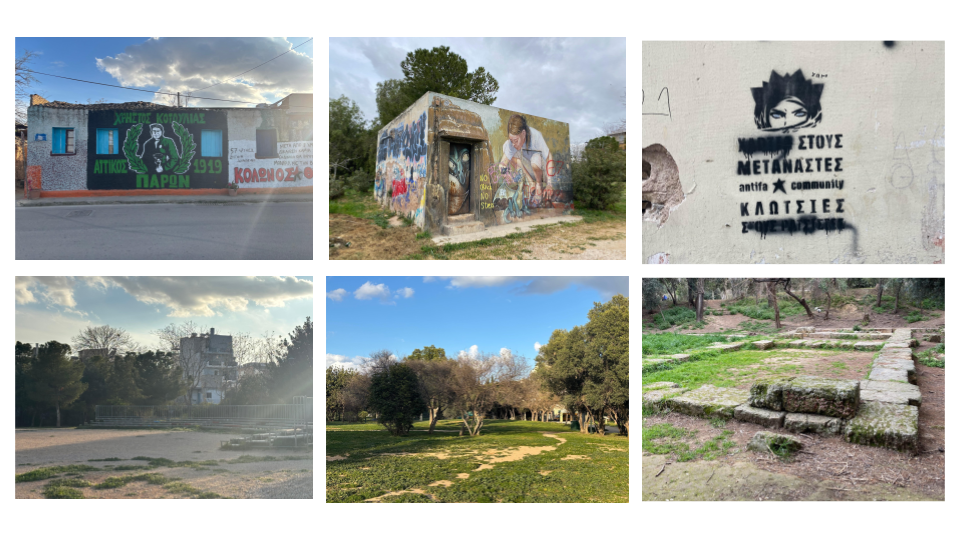

Site's visit outcome: interactive map highlighting traces where heritage and contemporary art melt


Mapped spaces to activate with our intervention
The proposal
Rather than a single new building, the proposal takes a two-pronged approach: building the organisational infrastructure — funding, partnerships, a small on-site cultural hub — needed to sustain artistic activity, alongside a physical “toolkit” of lighting, seating, and staging that can activate existing spaces in the park, from the amphitheatre to the archaeological ruins themselves. Drawing on precedents including Zusterhof in Brielle, Shakespeare in the Park, and Edoardo Tresoldi's site-responsive sculpture, the design favours demountable, participatory structures over permanent construction, allowing residents to shape the park's artistic life as it grows — from small-scale interventions in its first five years to, potentially, a recognised art hub within the wider city within thirty.


